On this page (16)
- What is the awareness stage?
- Two kinds of awareness
- 7 awareness channels for small businesses
- 1. Google Business Profile
- 2. Short-form video
- 3. Helpful blog posts and search
- 4. Social media ads with broad local targeting
- 5. YouTube
- 6. Collaborations and local partnerships
- 7. Offline touchpoints that lead online
- What awareness content looks like
- How to measure awareness
- Common awareness mistakes
- What comes next
- Key takeaways
- Want more of the right people to discover your business?
This is part 1 of our 4-part funnel series. New to funnels? Start with What Is a Marketing Funnel? A Plain-English Guide.
Every customer you’ve ever had started as a stranger. Before they compared you with competitors, before they asked for a price, before they bought, they first had to notice you.
That first step is the awareness stage, the top of your marketing funnel. Get it wrong, and nothing else matters: your great website, offers and follow-ups never get a chance. Get it right, and you have a steady stream of the right people discovering your business.
This guide explains what awareness marketing really is, which channels work for small businesses, what to post and run, and how to tell whether it’s working.
In this post:
- What the awareness stage is (and isn’t)
- The two kinds of awareness: problem and brand
- 7 awareness channels for small businesses
- What awareness content looks like
- How to measure awareness without obsessing over sales
What is the awareness stage?
The awareness stage is when someone first comes across your business, or first realises they have a problem you can solve.
At this point, people are not ready to buy. They’re scrolling, searching, watching and asking around. Your job isn’t to close a sale. It’s to:
- Get in front of the right people (not everyone)
- Be memorable enough that they recognise you next time
- Give them a simple reason to take a small next step, like following you, visiting your website or saving your post
Pro tip: The biggest awareness mistake is talking to everyone. “Fresh cakes in Kothrud for birthday parties” will be noticed by far more of the right people than “Delicious cakes for every occasion”.
Two kinds of awareness
It helps to split awareness into two types, because they need different content.
| Type | What the person knows | Example for a dental clinic | Content that fits |
|---|---|---|---|
| Problem awareness | They have a problem, but don’t know the solution or who offers it | “Why do my gums bleed when I brush?” | Educational posts, blogs and videos that explain the problem |
| Brand awareness | They know the solution exists, but don’t know you | “Dentist near me” | Google Business Profile, local ads, reviews and recognisable branding |
Most small businesses should do both. Problem-aware content builds trust early. Brand-aware visibility makes sure you’re the name they remember when they’re ready.
7 awareness channels for small businesses
You don’t need all of these. Pick two or three that match where your customers already spend time.
1. Google Business Profile
For local businesses, this is often the most valuable awareness channel there is. When people search “near me” or for a service in your area, your profile, photos and reviews can show up before your website does. Keep it complete and active. Our Google Business Profile checklist walks you through it.
2. Short-form video
Instagram Reels and YouTube Shorts can be shown to people who don’t follow you yet. That makes them one of the best free ways to reach new people. Show your work, teach something quick or take people behind the scenes. See our guide to short-form video for business for ideas.
3. Helpful blog posts and search
Write answers to the questions customers ask before they’re ready to buy. A blog post that answers “How often should I service my AC?” can bring in readers from Google for months or years.
4. Social media ads with broad local targeting
Paid social ads let you reach people in your area who match your audience, even if they’ve never heard of you. For awareness, keep the message simple, use video or eye-catching images, and optimise for reach or video views rather than sales.
5. YouTube
Longer how-to videos, product demos and FAQs work especially well for businesses with something to explain, such as coaching, home improvement, finance or healthcare.
6. Collaborations and local partnerships
Partner with complementary businesses, local pages, creators or community groups. A bakery and a party decorator, or a gym and a nutritionist, can introduce each other to new customers.
7. Offline touchpoints that lead online
Signboards, packaging, flyers, events and stalls still build awareness. Add a QR code or WhatsApp link so people can find you online later.
What awareness content looks like
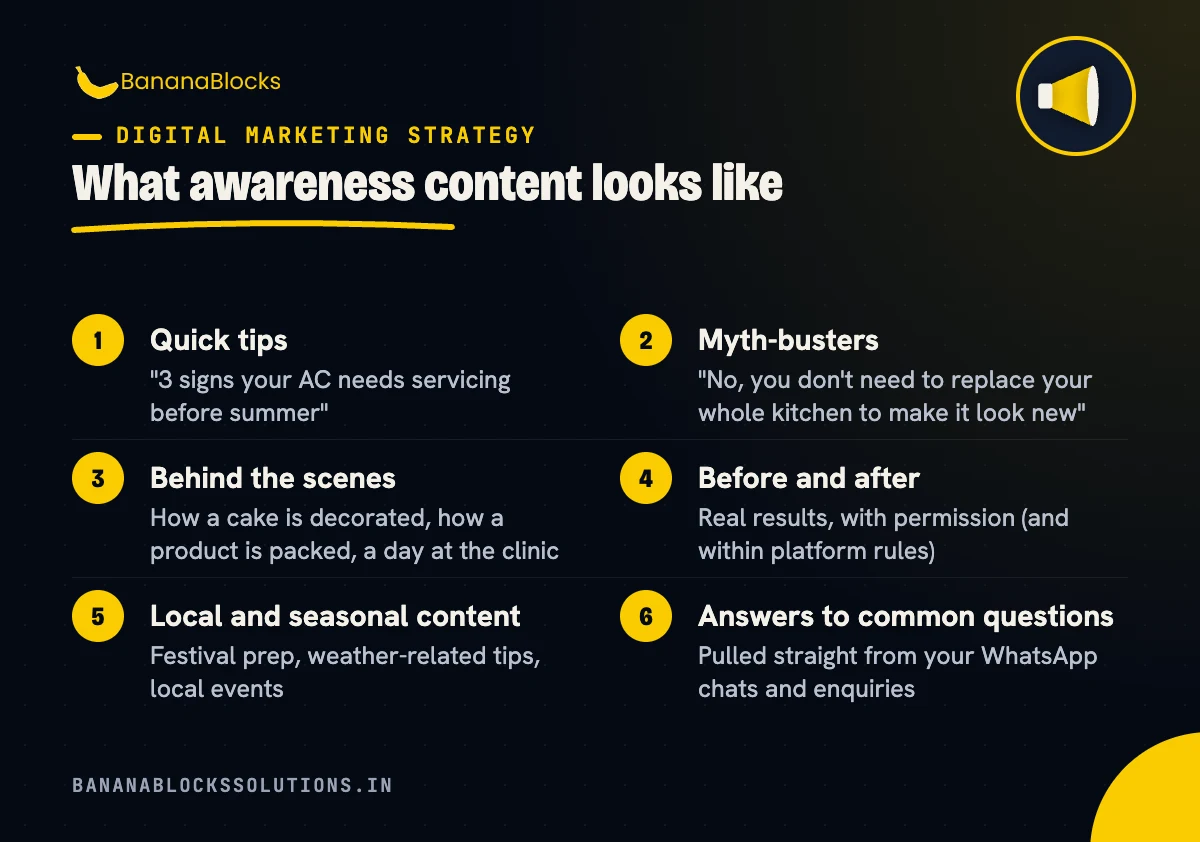
Good awareness content is useful, interesting or entertaining before it’s promotional. Here are formats that work:
- Quick tips: “3 signs your AC needs servicing before summer”
- Myth-busters: “No, you don’t need to replace your whole kitchen to make it look new”
- Behind the scenes: How a cake is decorated, how a product is packed, a day at the clinic
- Before and after: Real results, with permission (and within platform rules)
- Local and seasonal content: Festival prep, weather-related tips, local events
- Answers to common questions: Pulled straight from your WhatsApp chats and enquiries
Every piece should still carry your name, logo or recognisable style, so people connect the content with your business.
Pro tip: Add one soft next step to every awareness post, such as “Follow for more tips”, “Save this for later” or “See our full guide on our website”. Don’t ask for the sale yet.
How to measure awareness
Awareness content rarely leads straight to a sale, so don’t judge it on sales alone. Track these instead:
| Metric | Where to find it | What it tells you |
|---|---|---|
| Reach and impressions | Meta Business Suite, YouTube Studio, Google Business Profile | How many people saw you |
| Video views and watch time | Instagram Insights, YouTube Studio | Whether your content holds attention |
| Profile visits and new followers | Instagram and Facebook Insights | Whether people want to know more |
| Search views and actions | Google Business Profile performance | How often you show up locally, and what people do next |
| Branded searches | Google Search Console | Whether more people are searching for your name |
| New website visitors | Google Analytics | Whether awareness is feeding the next stage |
Look at trends over a few months rather than day-to-day numbers. Awareness builds slowly.
Common awareness mistakes
- Targeting everyone. Broad messages are easy to ignore. Be specific about who you help.
- Selling too hard, too soon. “Buy now” on a first impression often gets scrolled past.
- Posting inconsistently. Awareness depends on repetition. A steady rhythm beats occasional bursts.
- No branding. If people enjoy your content but can’t tell it’s yours, you’ve helped someone else.
- No next step. Even awareness content needs a gentle way to stay connected.
- Giving up too early. Awareness takes weeks or months to show results, not days.
What comes next
Once people know you exist, they start comparing their options. That’s the consideration stage, where you build trust and show why you’re the right choice. Read part 2: Consideration Stage Marketing: How to Win Trust When Customers Compare Options.
Key takeaways
- ✅ Awareness is about being noticed by the right people, not making a sale
- ✅ Create both problem-aware and brand-aware content
- ✅ Pick two or three channels where your customers already spend time
- ✅ Lead with useful, interesting content, and keep your branding visible
- ✅ Add one soft next step to every awareness post
- ✅ Measure reach, views, followers and branded searches over months
Want more of the right people to discover your business?
Awareness works best when your content, ads and local presence work together.
BananaBlocks Solutions helps small and growing businesses get discovered, with short-form video, social media ads, local SEO and content that brings the right people to the top of the funnel.
Book a free 30-minute strategy call and we’ll show you the quickest ways to reach more of your ideal customers.

Written by
Andrew Akshat
Writes for the BananaBlocks team about websites, SEO and digital growth for small and growing businesses.
More on Digital Marketing Strategy