On this page (10)
- 1. Microsoft Advertising: declare AI-made images and video
- 2. Google Shopping ads can now show “sold” badges
- 3. Google wants you to track appointments and real conversion values
- 4. Google Business Profile: booking button controls and a simpler appeal form
- 5. Google policy and billing: sexual content examples and 2027 surcharges
- 6. ChatGPT Ads: reach metrics, business agents beyond the US, and healthcare
- Upcoming deadlines
- Key takeaways
- Want help keeping up?
- References
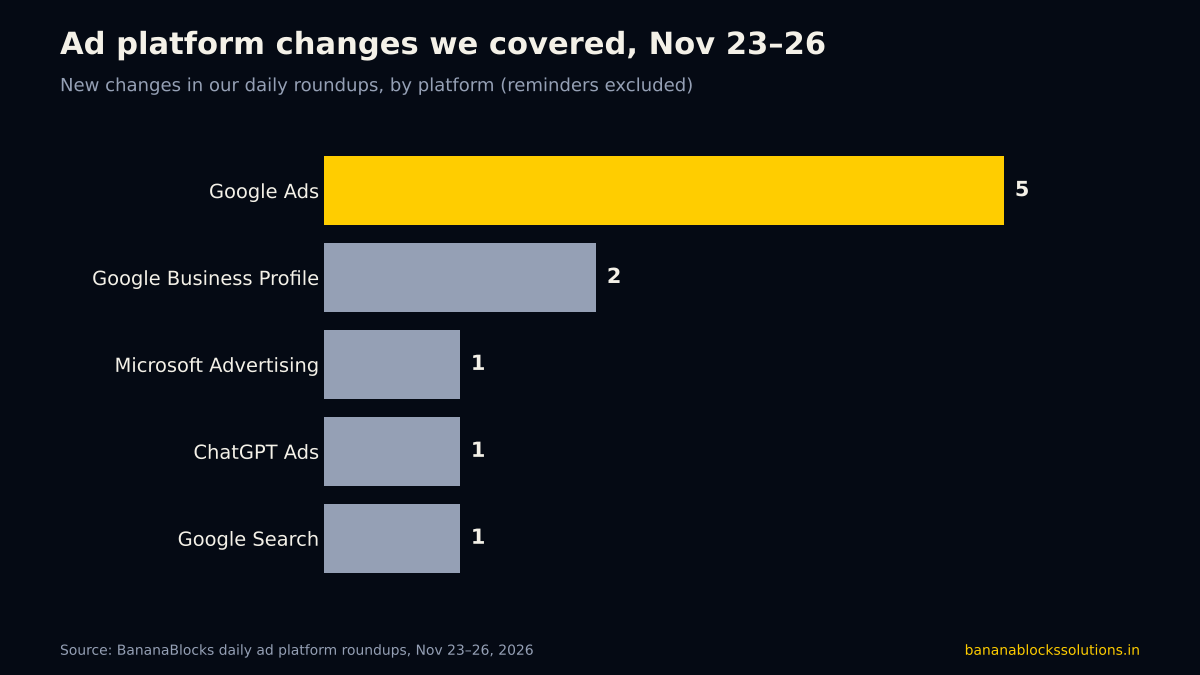
Black Friday week was quieter than usual for big launches, but the changes that did land are practical ones. Microsoft Advertising now lets you declare AI-made ad images and video, Google Shopping ads can show “sold” badges, Google is nudging advertisers to track appointments and real conversion values, Google Business Profile owners get more control over booking buttons, and Google’s ad surcharges change in three European countries from January 1. ChatGPT Ads also kept growing, with new reporting and business agents outside the US.
This deep dive covers the week of November 23 to 27, 2026: what changed, why it matters for small businesses in India, who it affects, and what to do. Sources are listed at the end, with numbered links in the text.
In this deep dive:
-
- Microsoft Advertising: declare AI-made images and video
-
- Google Shopping ads can now show “sold” badges
-
- Google wants you to track appointments and real conversion values
-
- Google Business Profile: booking button controls and a simpler appeal form
-
- Google policy and billing: sexual content examples and 2027 surcharges
-
- ChatGPT Ads: reach metrics, business agents beyond the US, and healthcare
- Upcoming deadlines
1. Microsoft Advertising: declare AI-made images and video
What changed: In its November update, Microsoft said “AI content transparency controls are now generally available in Microsoft Advertising.” Advertisers can declare AI-generated image and video content, choose a visible watermark where supported, and manage declarations in bulk. The controls cover Product Ads, Multimedia Ads, Audience Ads, Display Ads, Video Ads and Performance Max assets, and Microsoft says advertisers remain responsible for their own disclosures [1]. Search Engine Roundtable spotted a “Made with AI” label showing in the corner of some ad images on Bing [2].
Why it matters for Indian SMBs: Many small businesses now make ad images with AI tools, and many import their Google Ads campaigns straight into Microsoft Advertising. Those imported images go live on Bing too. Labelling AI-made creative is becoming a normal part of running ads, and Google Ads has similar AI content labels.
Who it affects: Anyone running Microsoft Advertising campaigns with images or video, especially accounts imported from Google Ads.
What to do:
- Open your Microsoft Advertising asset library and list the images and videos that were made or heavily edited with AI.
- Declare those assets using the new transparency controls, and decide whether you want a visible watermark where it’s offered.
- Keep one simple record (a spreadsheet is fine) of which creative was made with AI, so you can declare it consistently on every platform.
2. Google Shopping ads can now show “sold” badges
What changed: Google published a help page on purchase signal annotations. In Google’s words, they highlight “high-demand items by showcasing purchase volume, such as ‘100+ sold last 30 days’, on eligible Shopping ads” [3]. Google says they’re designed to make high-performing products more competitive in Shopping, and they appear automatically, without extra budget or manual setup [4].
Why it matters for Indian SMBs: A “sold” badge is social proof right inside the ad, which can help a smaller online store stand out next to bigger brands. But you only get it if your tracking is set up properly.
Who it affects: Online stores running Shopping or Performance Max campaigns. Google says the badges are available globally except the EEA, the UK and Switzerland, on mobile and desktop search [3].
What to do:
- Check whether your Google Ads purchase conversion sends cart data (the products and quantities in each order). Google requires item-level sales reported through conversions with cart data [3].
- If it doesn’t, ask your developer or agency to add it.
- Remember that a product also has to pass a minimum sales threshold for privacy, so badges will show on your best sellers first.
3. Google wants you to track appointments and real conversion values
What changed: Two things this week pointed in the same direction. First, Google heavily revised its help page “About the Book Appointment conversion goal.” It explains how bookings from partner integrations, “book appointment” conversion actions and calls from ads can be grouped under one Book Appointment goal, which Google says “helps you measure and optimize campaigns to drive scheduled appointments” [5], [6]. The page also notes that Google Ads doesn’t allow appointment booking links or goals for healthcare campaigns.
Second, responding to a LinkedIn discussion, Google Ads Liaison Ginny Marvin said that feeding Google adjusted conversion values is “what we strongly encourage,” and that this is “already how Smart Bidding is designed to work” [7]. That’s guidance, not a new feature.
Why it matters for Indian SMBs: Smart Bidding only optimises for what you tell it. If every enquiry counts the same, Google will chase the cheapest enquiries, not the best customers. For appointment businesses, a booked appointment is a far better signal than a click on “Call”.
Who it affects: Salons, consultants, coaches, repair services, studios and any business that runs on bookings or leads of very different value. Clinics and other healthcare advertisers should read Google’s restriction first.
What to do:
- List your conversion actions in Google Ads (Goals > Summary) and check that bookings and calls from ads are tracked.
- If you run on appointments, group those actions under the Book Appointment goal so bidding optimises for booked slots.
- Give more valuable conversions higher values: for example, a qualified lead worth more than a basic enquiry, or real order value and margin for purchases.
- Change values gradually and give bidding a couple of weeks to adjust before judging the results.
4. Google Business Profile: booking button controls and a simpler appeal form
What changed: Business owners can now turn booking partner links on or off for appointments and restaurant reservations, choosing which booking buttons appear on their listing. A Google employee announced it on LinkedIn: “you now decide which booking buttons appear on your listing right from your dashboard.” It follows similar controls for food ordering added about a month earlier [8]. Separately, a local SEO specialist reported that the appeal process for suspended profiles is now a single form instead of a multi-step process. Google hasn’t announced this [9], [10].
Why it matters for Indian SMBs: For local businesses, the Business Profile is often seen more often than the website. A booking button that sends people to a platform you no longer use loses customers quietly. And a suspension can stop calls overnight, so a faster appeal matters.
Who it affects: Salons, clinics, studios, restaurants and any local business with a Google Business Profile.
What to do:
- Open your Business Profile and check which booking or reservation buttons appear. Turn off any that link to services you don’t use.
- Keep evidence ready in case of a suspension: photos of your signage and premises, a business registration or GST document, and a utility bill or similar proof of address.
- If you’re suspended, appeal only through Google’s official form [10]. Our Google Business Profile checklist covers the rest.
5. Google policy and billing: sexual content examples and 2027 surcharges
What changed: Google updated its sexual content advertising policy with many new examples covering nudity, partial nudity, sexual merchandise and sexual entertainment. Google says the update “does not change enforcement of the policy” [11], [12].
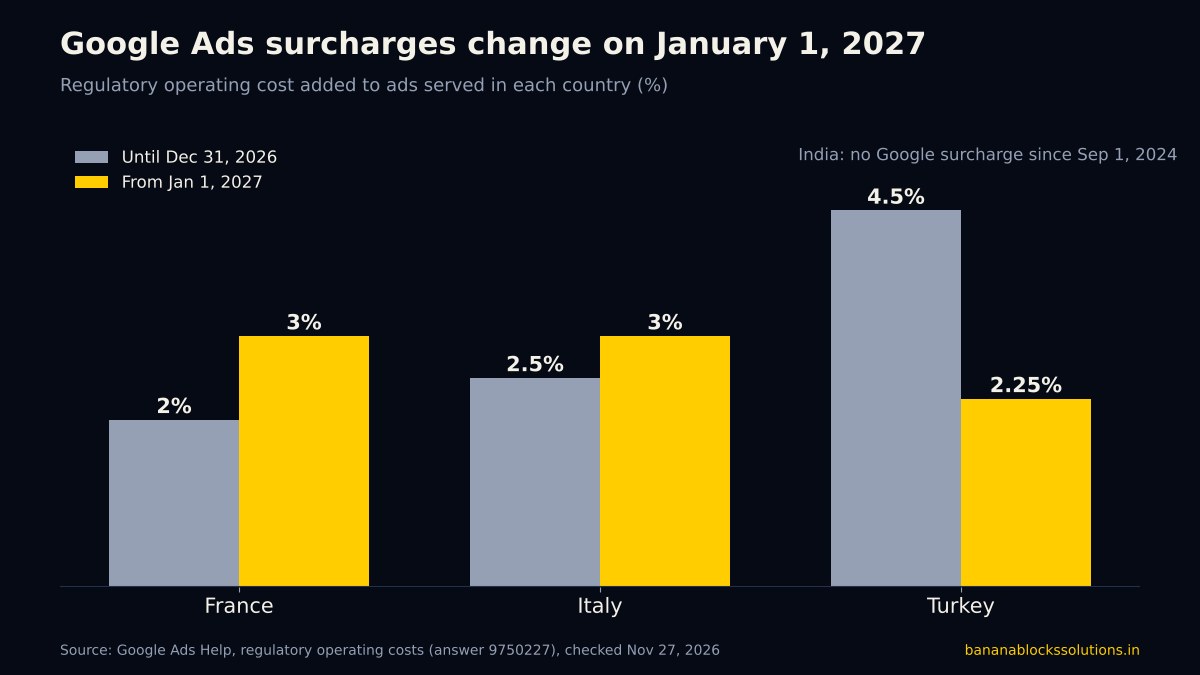
Google also confirmed surcharge changes from January 1, 2027. Its help page says a 3% regulatory operating cost will apply to ads served in France (up from 2%) and in Italy (up from 2.5%), while Turkey’s falls from 4.5% to 2.25% [13], [14]. The surcharge depends on where the ads are served, not where the advertiser is based. The same page confirms that ads served in India have not carried the 2% surcharge since September 1, 2024 [13].
Why it matters for Indian SMBs: The policy examples matter if you sell lingerie, intimate wellness products or anything close, because disapprovals during a sale are costly. The surcharges matter if you export, sell to the Indian diaspora in Europe, or run tourism or education campaigns aimed at those countries.
Who it affects: Lingerie, wellness and similar retailers (policy); businesses targeting France, Italy or Turkey (surcharges).
What to do:
- If you’re in a sensitive category, read the new examples and check your images and landing pages before your next campaign.
- If you target France or Italy, add the extra 1% (France) or 0.5% (Italy) of spend to your 2027 budget. Our 2027 marketing budget guide has a simple template.
- If you only serve India, check your location settings to make sure ads aren’t showing abroad by accident.
6. ChatGPT Ads: reach metrics, business agents beyond the US, and healthcare
What changed: OpenAI emailed advertisers a ChatGPT Ads product update. Business Agents can now be created by eligible businesses in supported markets outside the US and added to campaigns as Sponsored Business Agents; single image ads show a “Learn more” link by default; and Ads Manager adds audience metrics such as reach and frequency [15], [16]. PPC Land notes the email named further metrics without defining them, and didn’t explain how unique people are counted [17]. OpenAI didn’t list which markets are supported.
In a separate development, WebMD Ignite announced on November 24 that it will plan, run and measure ChatGPT ad campaigns for hospitals and health systems, with OpenAI still deciding eligibility, creative approval and delivery [18]. OpenAI’s ad policy says healthcare ads “are allowed on a limited basis when pre-approved by OpenAI” [19].
Why it matters for Indian SMBs: ChatGPT Ads is still new, and reach and frequency reporting makes it easier to compare with other channels. But most small businesses don’t need to move budget yet, and healthcare remains tightly controlled.
Who it affects: Ecommerce and online service businesses curious about ChatGPT Ads; hospitals and clinics (restricted).
What to do:
- If you’re curious, check OpenAI’s help pages to see whether your market and business type are supported before planning any budget.
- If you test it, start with a small amount from your test fund, not from the channels that already work.
- Compare cost per lead or sale with Google and Meta, not just reach.
Upcoming deadlines
We re-checked every date below on November 27, 2026.
| Date | What happens | Who should act |
|---|---|---|
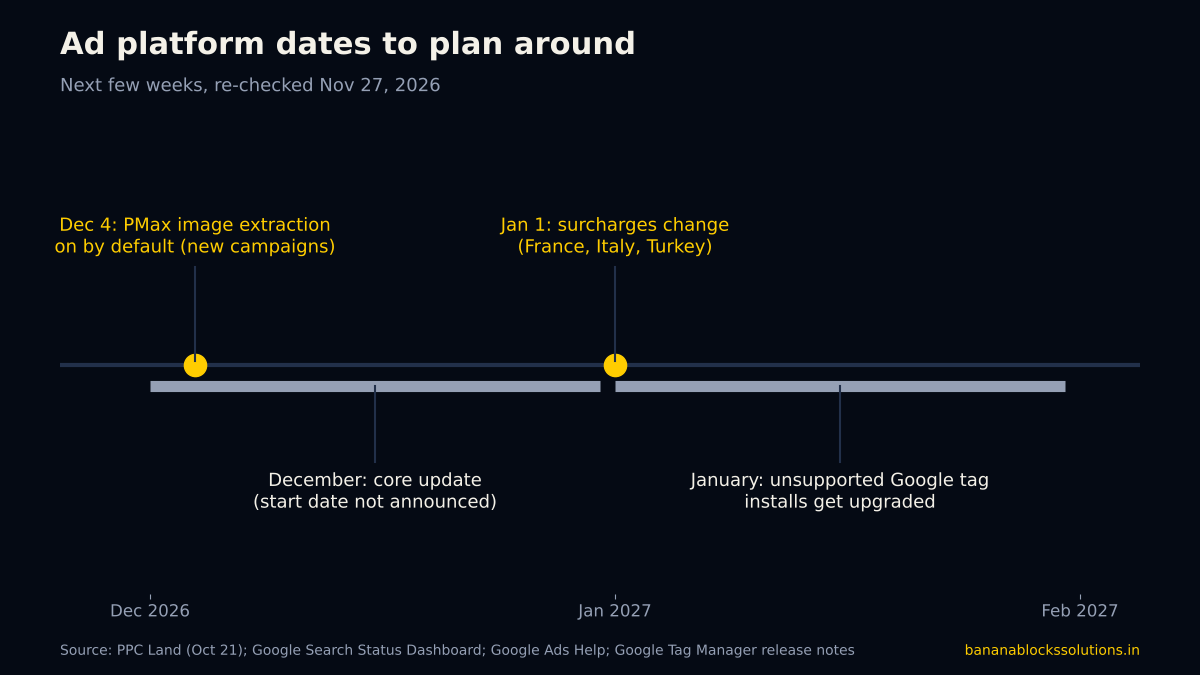
| December 4, 2026 | Image extraction is switched on by default for newly created Performance Max campaigns, even if dynamic images are off at account level. Existing campaigns keep their settings [20] | Anyone launching new PMax campaigns |
| December 2026 (date not announced) | Google’s December 2026 core update; Google says it “is scheduled to be released in December 2026” and hasn’t started yet [21] | Website owners (organic rankings, not ads) |
| January 1, 2027 | Google surcharges: France 3%, Italy 3%, Turkey 2.25% [13] | Advertisers targeting those countries |
| January 2027 | Unsupported Google tag installations receive the Tag Manager upgrade [22] | Anyone unsure how their Google tag is installed |
| On hold | Meta’s updated Commercial Terms: “These updates are on hold. The existing Commercial Terms remain in effect until further notice” [23] | No action needed for now |
Key takeaways
- ✅ Declare AI-made images and video in Microsoft Advertising
- ✅ Send cart data with purchase conversions to qualify for “sold” badges
- ✅ Track booked appointments and give better leads higher conversion values
- ✅ Check the booking buttons on your Google Business Profile
- ✅ Budget for higher surcharges if you advertise in France or Italy in 2027
- ✅ Test ChatGPT Ads only from a small test budget, if at all
- ✅ Check image extraction before launching new Performance Max campaigns after December 4
Want help keeping up?
BananaBlocks Solutions manages Google, Microsoft and Meta ad campaigns for small and growing businesses, and keeps them up to date as the platforms change.
Book a free 30-minute ads review and we’ll check your account against this week’s changes.
References
- Microsoft Advertising, “Put AI to work engaging customers in more places: What’s new in Microsoft Advertising this November,” Nov 19, 2026. Link
- Search Engine Roundtable, “Made with AI” label on Bing ads, Nov 2026. Link
- Google Ads Help, “About purchase signal annotations.” Link
- Search Engine Roundtable, Google Ads purchase signal annotations, Nov 2026. Link
- Google Ads Help, “About the Book Appointment conversion goal.” Link
- Search Engine Roundtable, Google Ads Book Appointment conversion goal, Nov 2026. Link
- Search Engine Roundtable, “Google Ads Encourages Dynamically Scoring Conversion Values,” Nov 25, 2026. Link
- Search Engine Roundtable, Google Business Profiles appointment booking and reservation controls, Nov 2026. Link
- Search Engine Roundtable, Google Business Profiles appeals form simplified, Nov 2026. Link
- Google Business Profile Help, manage appeals. Link
- Google Advertising Policies Help, sexual content policy update. Link
- Search Engine Roundtable, Google expands sexual content advertising policy, Nov 2026. Link
- Google Ads Help, regulatory operating costs and surcharges. Link
- PPC Land, “Google Ads surcharges hit 3% in France and Italy from January 2027,” Nov 2026. Link
- Search Engine Roundtable, “ChatGPT Ads New Call-To-Actions, Business Agents Beyond US, More Audience Metrics & More,” Nov 25, 2026. Link
- OpenAI Help Center, “Setting up a Sponsored Business Agent in Ads Manager.” Link
- PPC Land, “ChatGPT ad reports add 9 metrics built on how many people see the ads,” Nov 26, 2026. Link
- PPC Land, “WebMD Ignite runs ChatGPT ads for hospitals, but OpenAI decides who gets in,” Nov 26, 2026. Link
- OpenAI, Ad policies. Link
- PPC Land, “Google turns on PMax image extraction by default from December 4,” Oct 21, 2026. Link
- Google Search Status Dashboard, December 2026 core update (preannounced Nov 24, 2026). Link
- Google Tag Manager Help, Release notes (Nov 17, 2026: “Google tag and Google Tag Manager unification”). Link
- Meta, Commercial Terms (notice: updates on hold). Link
- BananaBlocks, daily ad platform roundups for Nov 23, 24, 25 and 26, 2026 (source for the “changes by platform” chart): Nov 23, Nov 24, Nov 25, Nov 26

Written by
Andrew Akshat
Writes for the BananaBlocks team about websites, SEO and digital growth for small and growing businesses.
More on Ad Platform Updates