On this page (29)
- 1. Microsoft upgrades its bidding and puts ads in Bing’s AI Overviews
- What changed
- Why it matters for Indian SMBs
- Who it affects
- What to do
- 2. Google tag and Google Tag Manager are merging
- What changed
- Why it matters for Indian SMBs
- Who it affects
- What to do
- 3. Holiday promotions: new rules and new settings
- What changed
- Why it matters for Indian SMBs
- Who it affects
- What to do
- 4. Google’s new advice on testing ad changes
- What changed
- Why it matters for Indian SMBs
- Who it affects
- What to do
- 5. More control over AI-made ads on Google and Meta
- What changed
- Why it matters for Indian SMBs
- Who it affects
- What to do
- Upcoming deadlines
- Key takeaways
- Want help keeping up?
- References
Every Friday, we step back from the daily news and look at the ad platform changes that matter most for small and growing businesses in India: what changed, why it matters, who it affects and exactly what to do.
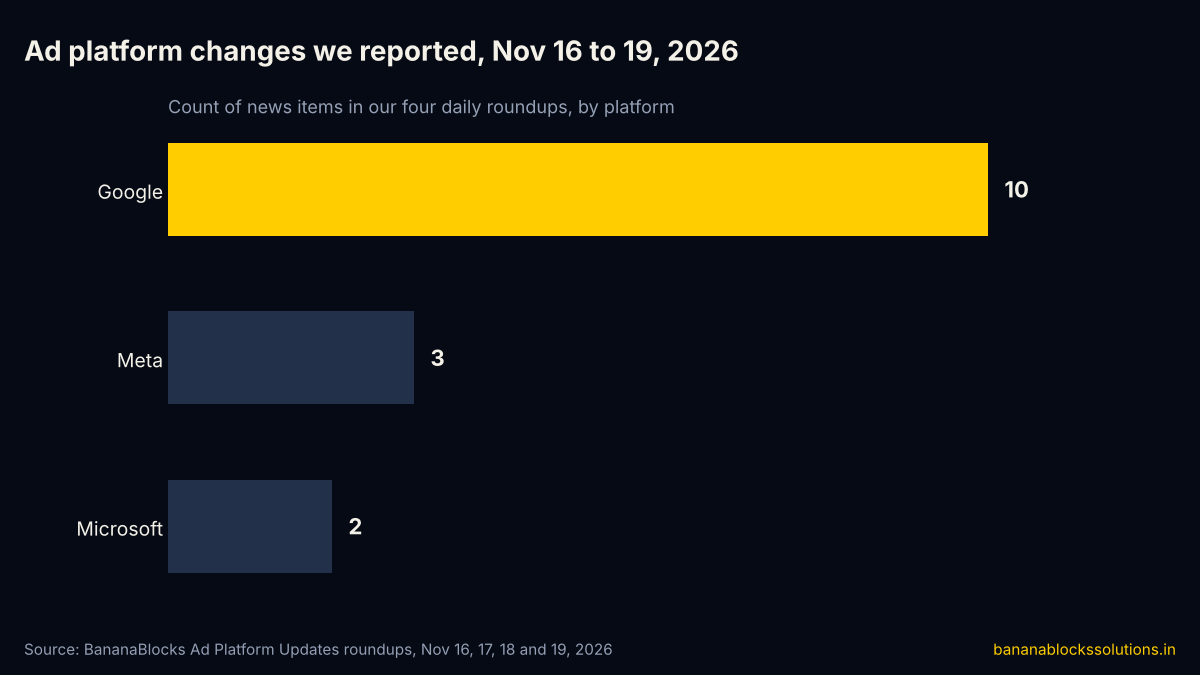
This week, Microsoft made the biggest moves: a major upgrade to its automated bidding and ads in Bing’s AI Overviews, now live in India. Google announced it’s merging the Google tag with Google Tag Manager, tightened its promotion rules just before Black Friday, and shared new advice on testing. Meanwhile, Meta and Google both added new ways to steer AI-made ads.
This week’s big five:
- Microsoft upgrades its bidding and puts ads in Bing’s AI Overviews
- Google tag and Google Tag Manager are merging
- Holiday promotions: new rules and new settings on Google and Meta
- Google’s new advice on testing ad changes
- More control over AI-made ads on Google and Meta
1. Microsoft upgrades its bidding and puts ads in Bing’s AI Overviews
What changed
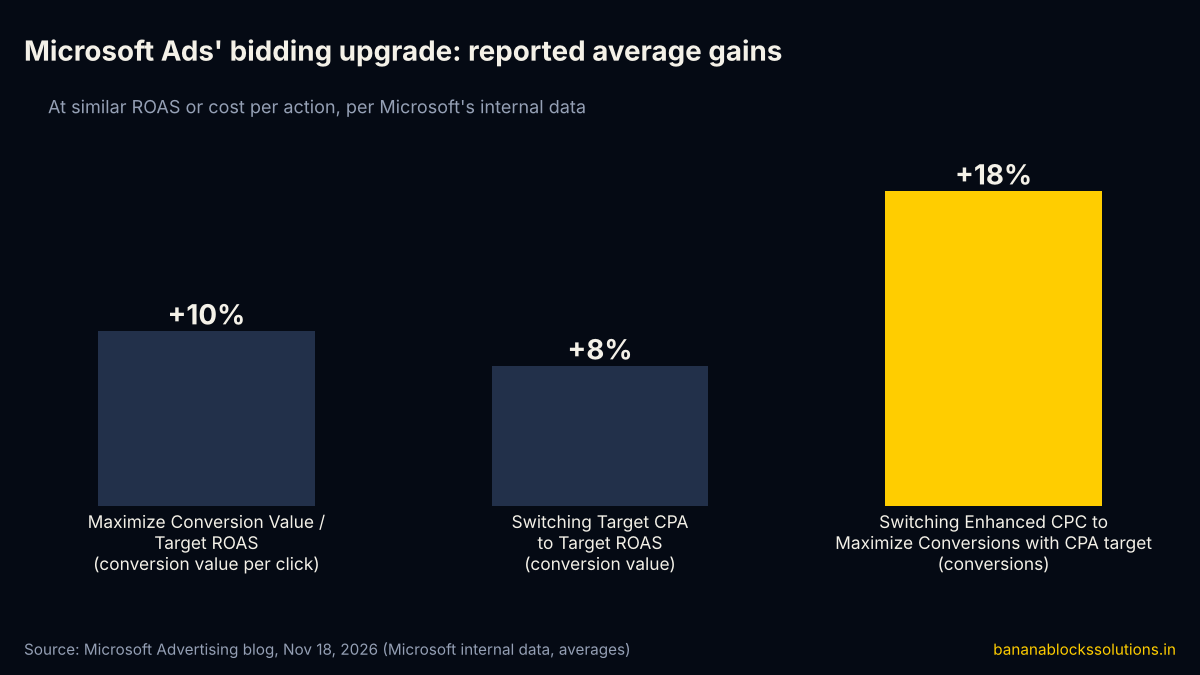
On November 18, Microsoft Advertising announced what it calls “the biggest upgrade to bidding models in a decade” [1]. Based on Microsoft’s internal data, advertisers using Maximize Conversion Value or Target ROAS saw about 10% more conversion value per click at a similar ROAS on average. Search advertisers switching from Target CPA to Target ROAS saw about 8% more conversion value, and those switching from Enhanced CPC to Maximize Conversions with a CPA target saw about 18% more conversions at a similar cost per action. Microsoft also says bids now adjust nearly twice as quickly when you change a CPA or ROAS target, and budgets pace more evenly through the day. The upgrade rolls out automatically [1], [4].
A day later, Microsoft confirmed that ads in AI Overviews on Bing “are now available in all markets except China,” running through existing campaigns, including Performance Max and AI Max, with “no separate campaign set-up required” [2], [3]. The same update lists Microsoft’s new Discover feed (on the Edge new tab page and Windows) as live in India, along with the US, Canada, UK and Australia [2].
Why it matters for Indian SMBs
Most small businesses in India focus on Google and Meta, and many have never tried Microsoft Ads. These changes make it a little easier to start: automated bidding should need less babysitting, and your ads can now reach people using Bing’s AI answers in India without any extra setup. Remember that Microsoft’s figures are averages from its own data, not a guarantee.
Who it affects
Anyone running Microsoft Ads, and Google Ads advertisers thinking about importing campaigns into Microsoft Ads to test a second search channel.
What to do
- Check your conversion tracking. Microsoft recommends Universal Event Tracking (UET), as automated bidding depends on it [1].
- Move off Enhanced CPC once your account has at least five conversions, which is Microsoft’s own threshold for starting a conversion-based strategy [1].
- Change targets gradually, in steps of about 15%, and remove maximum CPC caps that fight your CPA or ROAS target [1].
- If you’re new to Microsoft Ads, try importing one well-performing Google Search campaign with a small budget and judge it on cost per lead or sale after a few weeks.
2. Google tag and Google Tag Manager are merging
What changed
Google’s Tag Manager release notes for November 17 say Google is “bringing all the capabilities of Google Tag Manager to the Google tag.” Each Google tag becomes a Tag Manager container, each Google destination (such as Google Ads or Analytics) gets its own tag, and existing setups and triggers are preserved. Google says sites with an unsupported installation “will receive the upgrade in January 2027” and should adjust their setup before then [5], [6].
Why it matters for Indian SMBs
Many small business websites have the Google tag pasted directly into the site code, often by a developer who’s no longer around. This change gives those sites Tag Manager’s preview, debugging and version history, which makes it easier to check that conversions are being tracked. But any big change to tracking is also a chance for something to break, right when you need accurate data for holiday campaigns.
Who it affects
Every business using the Google tag (gtag.js) for Google Ads or Google Analytics, especially sites with custom or unusual installations.
What to do
- Find out how your tag is installed: directly in your site code, through a plugin, or through Google Tag Manager.
- Test your conversions now with a test order or enquiry, and note the results so you can compare after the change.
- Ask your developer or agency to check whether your setup counts as unsupported and fix it before January 2027 [5].
- Review who has access to your tags, as Tag Assistant access now follows Tag Manager container permissions [6].
3. Holiday promotions: new rules and new settings
What changed
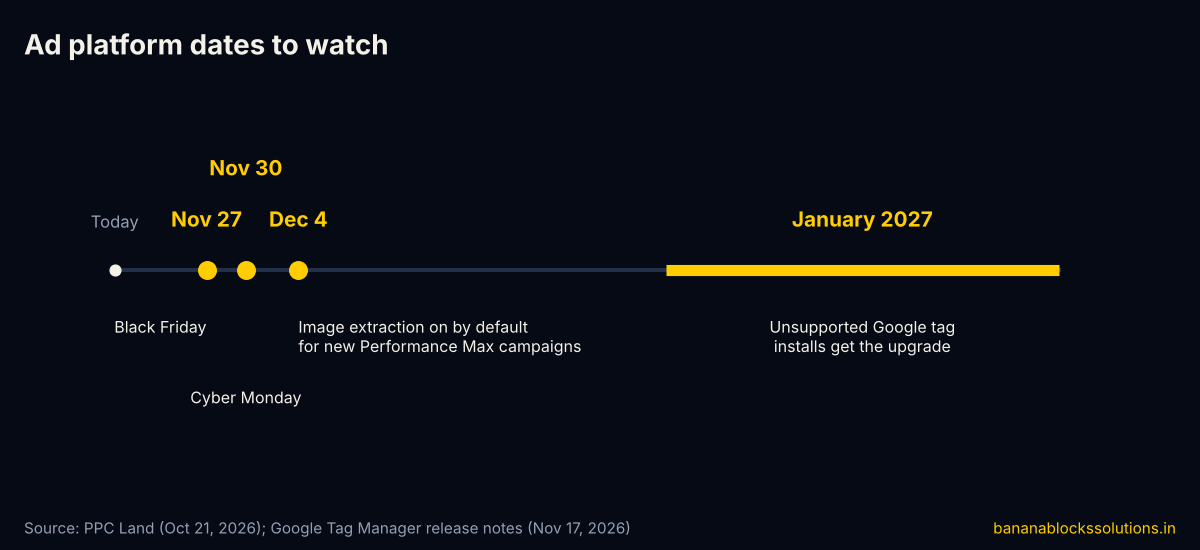
Several changes landed just before Black Friday (November 27) and Cyber Monday (November 30):
- Google Merchant Center: promotion titles must no longer include redemption dates “in any format” [7], [8].
- Google’s “Deal ends” badge for Shopping ads is no longer experimental, but Google’s help page lists India among the places where it isn’t available [9], [10].
- Performance Max: some advertisers now see Channel Prioritization and a Promo Mode under Budget when creating campaigns. Promo Mode lets you temporarily loosen your ROAS target and add extra daily budget for peak periods. Google hasn’t documented this yet [11].
- Meta: advertisers have reported Meta’s AI ad tools showing discounts they didn’t choose, through a Commerce Manager setting that displays offers Meta detects on your website and ads [12].
Why it matters for Indian SMBs
Black Friday and Cyber Monday sales are increasingly common in India, and a disapproved promotion or a wrong discount in an ad can cost a lot during a short sale. Because the “Deal ends” badge isn’t available in India, Indian advertisers need to show urgency in their own creative and landing pages.
Who it affects
Online stores using Merchant Center and Shopping or Performance Max campaigns, and any advertiser running offers through Meta ads.
What to do
- Remove dates from Merchant Center promotion titles and set them in the promotion’s date fields instead.
- Show your sale deadline yourself, in images, ad text and on the landing page.
- Check Commerce Manager’s offer setting and review AI-generated ad variations before your sale goes live.
- Use Promo Mode or seasonality adjustments carefully. Google says seasonality adjustments are “ideal for short events of 1–7 days” [21]. Set end dates and watch real profit, not just reported conversion value.
Our Cyber Monday ads checklist covers the rest of the setup.
4. Google’s new advice on testing ad changes
What changed
On its Ads & Commerce Blog and Ads Decoded podcast, Google shared guidance on running A/B tests in Google Ads. As reported by PPC Land, Google recommends starting with templated experiment setups that split traffic 50/50, measuring “qualified conversions rather than shallow proxies,” and giving tests four to six weeks to account for conversion lag. Google also says “an 80% confidence interval works well for directional tweaks,” and to reserve 95% certainty for major structural changes. PPC Land notes that some Google help pages still give different guidance on test length and confidence [13].
Why it matters for Indian SMBs
Small accounts rarely get enough conversions to reach 95% confidence quickly, so many small businesses either never test or call tests too early. Google’s advice gives you a practical middle ground for small changes like a new headline or landing page, as long as you judge them on real leads and sales.
Who it affects
Any Google Ads advertiser who changes bids, budgets, ads or landing pages.
What to do
- Use Google Ads Experiments rather than changing a live campaign and comparing “before and after.”
- Test one change at a time, and pick one business outcome to judge it on, such as cost per qualified lead.
- Run tests for four to six weeks, especially if customers take time to decide.
- Accept 80% confidence for small tweaks, but wait for stronger evidence before big changes such as switching bid strategies or restructuring campaigns.
5. More control over AI-made ads on Google and Meta
What changed
- Google Performance Max now has visual guidelines in Brand Guidelines, letting you “add style references and preferences to help steer how images are created and enhanced for your ads,” including up to three example images, according to Search Engine Roundtable [14].
- Meta Ads Manager has been spotted letting one ad carry up to five existing posts, with Meta showing “each person the one they’re most likely to engage with” [15].
- Meta Ads Manager has also been spotted offering a 6-second ThruPlay option for Awareness and Engagement campaigns, instead of the default 15 seconds [16].
The Google feature was seen in accounts; the two Meta changes were spotted in Ads Manager and haven’t been announced by Meta.
Why it matters for Indian SMBs
Both platforms increasingly create or choose ad creative for you. These controls help keep AI-made ads looking like your brand and make it easier to promote content that’s already working. The risk is judging success on engagement or cheap views rather than customers.
Who it affects
Performance Max advertisers using AI image generation or enhancement, and Meta advertisers promoting organic posts or running short video ads.
What to do
- Add two or three real brand images as visual guidelines in Performance Max, and review AI-made images in your asset report.
- If you see the Meta multi-post option, use it to boost your best organic posts together, but judge results on enquiries or sales.
- Test 6-second ThruPlay only for short Reels-style videos, and compare it with the 15-second setting on outcomes like profile visits or messages.
Upcoming deadlines
We’ve re-checked every date below against its source.
| Date | What happens | What to do |
|---|---|---|
| November 27 and 30 | Black Friday and Cyber Monday | Submit promotions, test tracking and set budgets this week |
| December 4 | Image extraction is on by default for new Performance Max campaigns, even if dynamic images are off at account level; existing campaigns keep their settings [17] | Check the setting on any new Performance Max campaign |
| Q4 2026 | Google Hotel campaigns migrate to new Search campaigns for Travel, set up automatically [18] | Hotel advertisers: check notifications for your date, or switch early |
| January 2027 | Unsupported Google tag installations receive the Tag Manager upgrade [5] | Review your tag setup before then |
| No date set | Meta’s updated Commercial Terms remain on hold; “the existing Commercial Terms remain in effect until further notice” [19], [20] | No action needed |
Key takeaways
- ✅ Check UET tracking and move off Enhanced CPC in Microsoft Ads once you have enough conversions
- ✅ Find out how your Google tag is installed and test conversions before January 2027
- ✅ Remove dates from Merchant Center promotion titles and show deadlines in your own creative
- ✅ Check Meta’s offer detection setting before your sale
- ✅ Use Google Ads Experiments and judge tests on real business outcomes
- ✅ Add brand visual guidelines to Performance Max
- ✅ Note December 4 and January 2027 in your calendar
Want help keeping up?
Platforms change every week, and the holiday season is the worst time to miss something. BananaBlocks Solutions manages Google, Microsoft and Meta campaigns for small and growing businesses, and keeps settings, tracking and promotions up to date.
Book a free 30-minute ads review and we’ll check your account against this week’s changes.
References
- Microsoft Advertising, “Building the next generation of automated bidding at Microsoft Advertising,” Nov 18, 2026. Link
- Microsoft Advertising, “Put AI to work engaging customers in more places: What’s new in Microsoft Advertising this November,” Nov 19, 2026. Link
- Search Engine Roundtable, “Microsoft Confirms Ads Are In AI Overviews On Bing Search,” Nov 19, 2026. Link
- Search Engine Roundtable, “Microsoft Advertising Announces Biggest Upgrade To Bidding Models,” Nov 18, 2026. Link
- Google Tag Manager Help, Release notes (Nov 17, 2026: “Google tag and Google Tag Manager unification”). Link
- Search Engine Roundtable, “Google Tag & Google Tag Manager Unification,” Nov 17, 2026. Link
- Google Merchant Center Help, promotions editorial requirements. Link
- Search Engine Roundtable, Merchant Center promotion titles can’t include dates, Nov 2026. Link
- Google Merchant Center Help, “Deal ends” annotation. Link
- Search Engine Roundtable, “Deal ends” annotation removes experimental label, Nov 2026. Link
- Search Engine Roundtable, “Google Ads PMax Setup Now With Channel Prioritization & Promo Mode,” Nov 18, 2026. Link
- Social Media Today, Meta’s AI ads included unapproved discounts, Nov 2026. Link
- PPC Land, “Google says 80% confidence is good enough for directional ad tests,” Nov 19, 2026. Link
- Search Engine Roundtable, “Google Ads Brand Guidelines New Add Visual Guidelines,” Nov 17, 2026. Link
- PPC Land, “One Meta ad can now carry up to 5 existing posts,” Nov 17, 2026. Link
- PPC Land, “Six seconds can now count as a watched video ad on Meta,” Nov 16, 2026. Link
- PPC Land, “Google turns on PMax image extraction by default from December 4,” Oct 21, 2026. Link
- Google Ads Help, Hotel campaigns migration notice. Link
- Meta, Commercial Terms (notice: updates on hold). Link
- PPC Land, “Meta halts its Nov 20 terms that would let it crawl business websites,” Nov 8, 2026. Link
- Google Ads Help, “About seasonality adjustments.” Link

Written by
Andrew Akshat
Writes for the BananaBlocks team about websites, SEO and digital growth for small and growing businesses.
More on Ad Platform Updates